How to Build a Balanced Plate Without Counting Calories

Calories are important, but they aren’t everything.
Don’t get us wrong, for many people who are chronic overeaters, counting calories can be an effective way to relearn what a serving should look like.
However, for many people, calorie counting can lead to obsession, inconsistency, unnecessary stress, or burnout.
Besides, you can’t log your food forever, and part of the weight loss journey towards better health is creating healthy habits you can sustain on your own.
Learning the components of a balanced plate helps give you the tools to make healthy food choices, whether you are at home, in a restaurant, or just reaching for a quick snack.
This approach is especially helpful for those with busy schedules, GLP-1 patients, and anyone looking to build long-term sustainable habits.
Today, we’ll learn how to create balance and nourish our bodies without any counting involved.
What Does a “Balanced Plate” Actually Mean?
At TeleHealthNP, we always encourage our patients to strive for balance, not perfection— but what does balance really mean?
To us, balance means making healthy choices most of the time, but leaving room to enjoy life. And sometimes that means a donut in the break room!
On your plate, balance means choosing the right combination of foods that leave you feeling satiated, stabilize your blood sugar, and support your energy and hormones.
You should feel satisfied after a meal, not restricted.
The Core Components of a Balanced Plate
Okay, so now that we understand what balance means in a broader sense, it’s time to get specific.
There are a few main components to focus on when it comes to making a meal: protein, fiber, and healthy fats.
1. Protein: The Anchor of Your Meal
Think of protein as having main character energy.
Protein makes you feel fuller, stabilizes your blood sugar, and helps to build muscle, which in turn, makes your metabolism run more efficiently.
A typical serving of protein should be about the size of your palm.
Animal-Based Protein Sources:
Chicken or turkey
Lean beef
Fish (salmon, tuna, cod, halibut)
Eggs
Greek yogurt
Cottage cheese
Plant-Based Protein Sources:
Lentils
Chickpeas
Black beans, kidney beans, pinto beans
Edamame
Tofu
Tempeh
Protein can also be found in smaller amounts in whole grains, nuts, and seeds, which are great sources of fiber and healthy fats, too!
2. Fiber-Rich Carbohydrates: give you energy and aid digestion
Carbohydrates have long been demonized by the diet industry, but the truth is, not all carbs are created equal. There is a big difference between refined and fiber-rich carbs.
Refined carbs are converted into sugar quickly by your digestive system, spike your blood sugar, and are not satiating.
Fiber-rich carbs give you energy, support fullness, and help with the digestive process.
A serving of fiber should be about the size of your fist.
Great sources of fiber:
Non-starchy vegetables (broccoli, Brussels sprouts, leafy greens, kale, bell peppers, zucchini, green beans, carrots, etc.)
Fruits (berries, apples with skin, pears, oranges, kiwi, avocados, etc.)
Whole grains (oats, quinoa, brown rice, whole wheat bread or pasta, etc.)
Beans and legumes
Nuts and seeds
3. Healthy Fats: For Flavor and Satisfaction
Fat is another nutrient that is misunderstood by many people. Natural sources of healthy fats actually serve an important role in your diet.
Healthy fats help your body to absorb nutrients, balance your hormones, increase your satiety, and make your meal more palatable and satisfying.
The suggested portion of healthy fats is about the size of your thumb.
Examples of healthy fats include:
Avocados
Greek yogurt
Nuts and seeds
Extra virgin olive oil
Oily fish (salmon, sardines)
Soy products (tofu, edamame)
The “Balanced Plate Method” Visual (No Math Required)
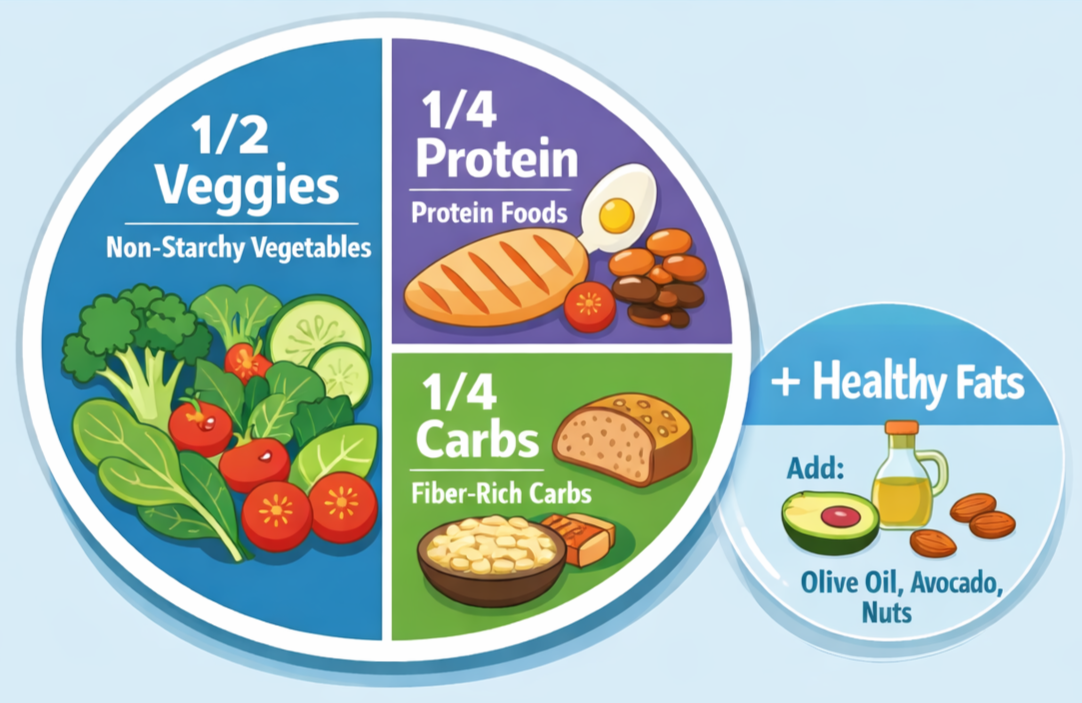
You might notice that a lot of these food choices have some overlap, containing two or more of the macronutrients you are looking for.
Don’t overthink it too much; it’s not about perfection, it’s about balance, remember?
Here’s your plate:
½ plate non-starchy vegetables
¼ plate protein
¼ plate fiber-rich carbs
Fat added intentionally (not avoided)
What About Snacks?
The balanced plate method works no matter where you are, whether making a home-cooked meal, eating out at a restaurant, or even snacking.
At a restaurant, you can replate your food to reflect the balance plate. Because restaurant portions are typically oversized, you can even ask for a box ahead of time and pack up the extra before you dig in.
When snacking, simply apply the same principles to a smaller portion that will get you through to your next meal.
Typically, we suggest pairing a protein and fiber for a balanced snack, such as:
Apple (fiber) and nut butter (protein + fat)
Cottage cheese (protein + fat) and strawberries (fiber)
Greek yogurt (protein + fat) and granola (fiber)
Avocado (fat + fiber) and whole grain toast (fiber + protein)
Practice a Balanced Plate & Build Trust With Yourself
This method works because it creates satisfying, balanced meals and snacks that promote blood sugar stability and reduced cravings throughout the day— without all the rules and counting.
The balanced plate helps you to control your portions naturally, without having to use an app.
Building confidence in your choices helps you to adhere to these new habits long-term, leading you to sustainable weight loss you can maintain.
Focus not on perfection, but on consistency, making every meal an opportunity to reinforce the small changes you are making to better your life.